
How to play 3D Nonogram What the numbers, circles and squares mean, then the deductions that carve a block down to its hidden model without guessing.
3D Nonogram is a nonogram played on a block of cubes instead of a flat grid. The rules fit in a paragraph and the game teaches them in 5 short lessons. This page sets them out in full, then goes through the deductions that finish a block, in the order you will need them.
A model is hidden in a block of cubes. Every line of cubes has a number: how many of its cubes belong to the model. A plain number means one group, a circle means exactly 2 groups, a square means 3 or more. Break every cube that does not belong, and what is left is the model. Every puzzle can be solved by deduction alone.
The rules
The block and the model
Each puzzle is a block of cubes, usually oblong rather than a perfect cube. Some of those cubes are the model; the rest are spare. Your job is to break every spare cube without breaking any of the model.
The number counts the cubes that stay
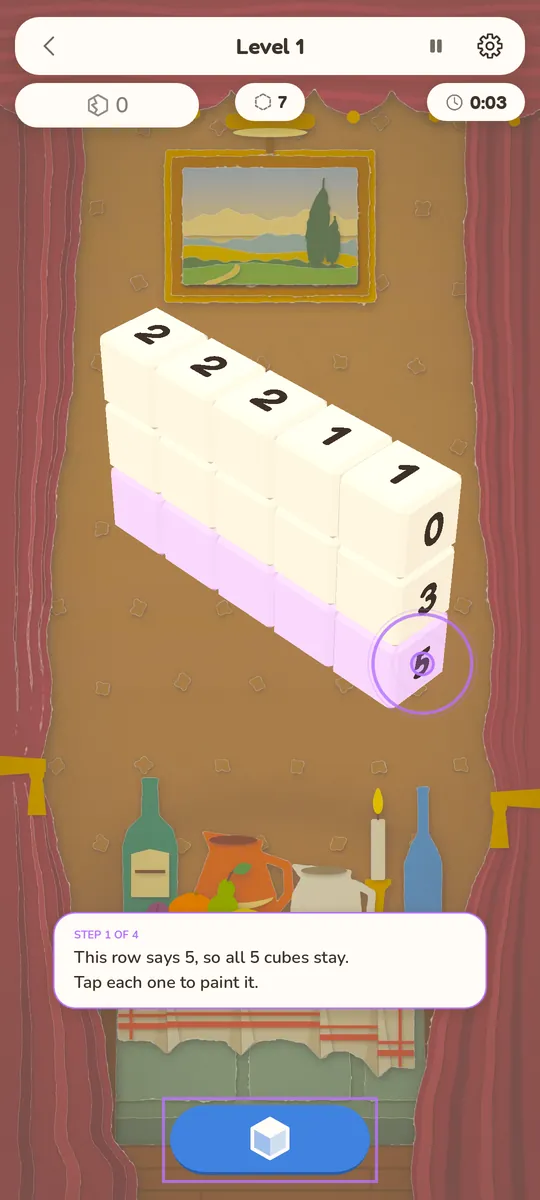
Every line of cubes through the block carries a number, shown on the faces at both ends. The number is how many cubes on that line belong to the model. A 5 on a line of 5 keeps them all. A 0 keeps none. Lines run in three directions: across, up, and front to back, so every cube sits on 3 lines and carries 3 numbers.
The marker says how they are grouped
- A plain number means the cubes on that line sit together in one group, with no gaps.
- A number in a circle means exactly 2 groups, so at least one space between them is empty. The circle does not say where.
- A number in a square means 3 groups or more, so at least 2 spaces between them are empty.
Blank sides and holes
Some sides are blank. A blank side does not mean 0: the line still has a number, you are just not told it, so you solve that line from the other lines through its cubes. Later puzzles also have holes, spaces that were never cubes at all. A hole splits a line just as a broken cube does, so a line of cube, hole, cube reads 2 with a circle.
Break, paint, and mistakes
You have two tools. Break removes a cube you have proved is spare. Paint marks a cube you have proved belongs to the model. Painting is free and never checked, and a painted cube is protected, so a stray tap cannot break it. To break a painted cube, remove the paint first.
Breaking a cube that belongs to the model is a mistake. It flashes red and is painted for you, so the mistake still leaves you the information it bought. With lives on, it costs 1 of 5 lives, and losing all 5 ends the attempt. Lives can be switched off, and then a mistake costs nothing but the no-mistakes star.
Undo takes back any break, paint or swipe, but never a mistake. In an ordinary puzzle you are finished the moment every spare cube is gone; painting what stays is optional.
The opening: two moves that need no thought
-
Clear every 0
A line marked 0 has no model cubes in it, so all of it goes. The app has a button that breaks every cube on every visible line marked 0 in one sweep. It is free, it leaves painted cubes alone, and it is always the right first move.
-
Keep every full line
If a line's number equals its length, every cube on it stays. Paint them. On a fresh block this is the only other place you can start: everything after is a cascade from these first certain lines.
The deductions
The game's own solver reads one line at a time and keeps going until nothing more follows. These are the arguments it uses, in roughly the order a puzzle asks for them. Every puzzle in the game can be finished with them.
-
The line is done
Once a line already holds as many painted cubes as its number, every other cube on it is spare: break them. The mirror case is just as useful. If the cubes left on a line exactly fill its number, they all stay. In the tutorial: a column that keeps 1 cube, and that cube is already painted, so the other 4 go.
-
The squeeze
A plain number is one group, and a group can only slide so far. A line of 5 that keeps 4 starts either at the first cube or the second, and either way the middle 3 stay. In general, push the group as far as it goes one way, then the other; the cubes covered both times are certain. The longer the group, the more it gives away.
-
A circle: where the gap cannot be
A circled number has 2 groups, so there is exactly one gap between them, one or more spaces wide. Take a line of 7 that keeps 6 with a circle: exactly 1 space is empty, and it cannot be at an end, because then the other 6 would be one group, not 2. So both end cubes stay. And a gap in the model puts a circle on every line that crosses it, which is worth looking for.
-
A square: very little room
3 or more groups need at least 2 gaps, so a squared number usually leaves only one way to fit. 4 cubes in 4 groups on a line of 7 can only be cube, gap, cube, gap, cube, gap, cube. Nothing else on the block would tell you that, so squares are worth reading early.
-
Cross the axes
Each cube is on 3 lines. A cube you settle on one line is a known cube on the two lines that cross it, and those lines often finish because of it. When you are stuck, stop staring at the line you were working and turn the block: the next deduction is usually on a line running the other way.
-
Work around blank sides
A hidden number is still a real number. Every cube on that line is also on 2 lines that may well show theirs, so start there. Later puzzles hide more numbers as they go, and the hardest chapter of the free pack is the one with the fewest numbers shown.
-
Peel to reach the middle
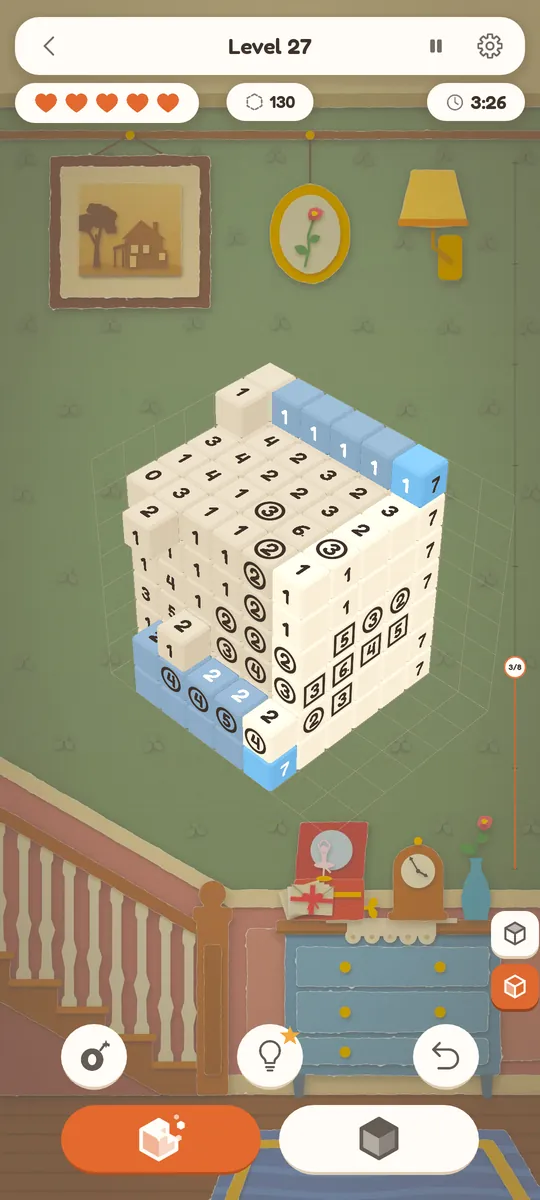
Lines buried in the block only show their numbers once the cubes in front are gone. The slice strip at the edge of the screen peels the block layer by layer, from the top or from whichever side faces you. While a layer is peeled, only the exposed layer can be changed. Peel whenever you need to see inside, and put the block back when you are done.
Two-colour puzzles
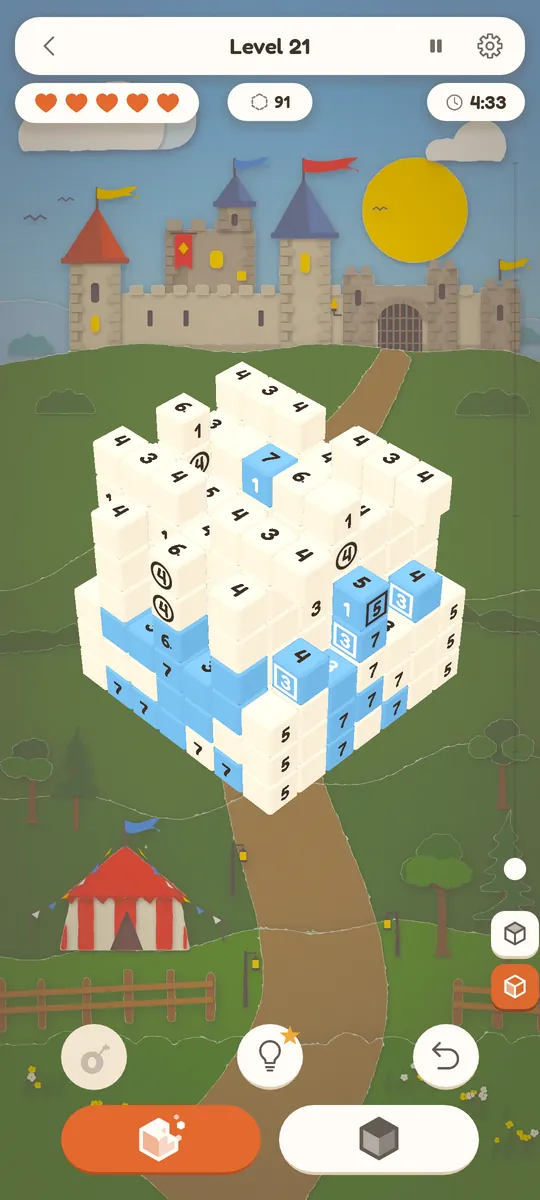
The Two Tones pack, and some chapters of the Landmarks and Animals packs, use two paints. Every cube that stays is either blue or green, and each colour has its own number.
- A blue number counts the blue cubes on that line; a green number counts the green ones.
- Two numbers on one side mean the line has both colours. Their order says nothing about where the cubes are.
- One number on a side means the line has only that colour. A neutral 0 means it has neither.
- The other colour splits a group. A circle on a blue number can mean the gap between the blue groups is green, not empty, so a circle does not always mean there is a space to break.
- Painting a cube the wrong colour is a mistake and costs a life, like breaking a model cube. Painting a spare cube is still free.
- To finish, every spare cube must be broken and every cube that stays painted its colour.
Controls in the app
- Tap a cube to break or paint it, depending on the tool selected.
- Press on a cube and drag along its line to break or paint the whole line in one move. Drag back to where you started to cancel. A break swipe stops at the first model cube, so a bad swipe costs 1 life, not 5.
- Drag beside the block to turn it. To turn it with your finger on the block, hold still for a moment before you drag.
- Pinch to zoom, pan with two fingers, and double-tap empty space to re-frame the block.
- Push the slice strip to peel layers. The buttons at its foot choose a top cut or a front cut; press the lit one again to put the block back.
- Hint: the first press lights the number you should be reading and its line, the second points at the cube. It never says whether to break or paint. Only the first hint in a puzzle costs a star. The Two Tones pack has no hint button.
- Count down clues is an optional setting that makes each number show what is left as you paint. It does not affect stars.
Each puzzle has 3 stars: one for solving it, one for making no mistakes, and one for using no hints. Mistakes count towards stars even with lives off.
Questions
What does a circle around a number mean?
The cubes on that line are in exactly 2 groups, with at least one empty space between them. The circle does not say where the gap is, but it can never be at either end of the line, because then the rest would be a single group.
What does a square around a number mean?
3 groups or more, so at least 2 gaps. Squares leave very little room and often fix a whole line on their own.
Does a blank side mean 0?
No. The number is hidden, not zero. Work the line out from the 2 other lines through each of its cubes. Puzzles with hidden numbers are still checked to need no guessing.
What happens if I break the wrong cube?
It flashes red and is painted for you. With lives on, it costs 1 of your 5 lives; with lives off, it only costs the no-mistakes star. A mistake is the one move Undo cannot take back.
Do I have to paint the cubes that stay?
Not in one-colour puzzles: breaking the last spare cube finishes the puzzle. Painting is a free note that also protects a cube. In two-colour puzzles, every cube that stays must be painted its colour.
How do I see inside the block?
Use the slice strip at the edge of the screen to peel layers off the top or the front. Only the exposed layer can be changed while it is peeled. Press the lit button again, or drag the strip back, to restore the block.
I am stuck. Do I have to guess?
No. Every puzzle in the game is checked by a solver that reads one line at a time, the way you do, and a puzzle it cannot finish by deduction does not ship. Turn the block and look at the lines running the other way; that is where the next move usually is. A hint will point you to it, at the cost of the no-hints star.
Play it
3D Nonogram is free on Google Play for Android, with 47 free puzzles and no ads. The first 5 are the lessons this page is based on.